Carr-Nelson Family Tree

The Civil War remains the deadliest war in American History, resulting in the deaths of an estimated

 750,000 soldiers and an undetermined number of civilian casualties. Historians estimate the death toll

at ten percent of all Northern males 20–45 years old, and 30 percent of all Southern white males aged

18–40.

Brief History of the 7th West Virginia Cavalry

Adapted from Loyal West Virginia 1861-1865, by Theodore F. Lang 

The Eighth Regiment, Virginia Infantry, (of the Union Army) was organized in the Kanawha Valley, by Major John H. Oley, during the fall of 1861, headquarters being at Charleston. The regiment was ordered to New Creek in April, 1862, becoming a part of General Fremont's Mountain Department, and with the Sixtieth Ohio Infantry, was organized as an advance brigade, and placed under the command of Colonel Cluseret, A.D.C. to General Fremont. In the pursuit of Stonewall Jackson up the Shenandoah Valley, this brigade had the advance, and were engaged in several skirmishes with Turner Ashby's cavalry, following him closely to Harrisonburg, where they engaged him, resulting in the death of Ashby. This brigade occupied the center at the Battle of Cross Keys and was complimented by General Fremont for its gallantry.

The regiment became a part of General Bohlen's brigade, Sigel's Corps, in General John Pope's campaign, and served with great gallantry in all the engagements of that campaign, including the Second Battle of Bull Run. On arriving at Washington, D.C., the regiment was transferred to General Milroy's brigade, and returned with him to western Virginia, and was again assigned to duty in the Kanawha Valley. In November, 1862, it was transferred to Colonel Moor's brigade. On the assignment of General Averell to the Fourth Separate Brigade, this regiment was mounted, and became a part of his brigade, as the Seventh West Virginia Cavalry, with which it served as long as the organization existed.

The regiment spent the last years of its term in the Kanawha Valley, occupying the following different posts: Charleston, Coalsmouth, Winfield, Point Pleasant, and Guyandotte. Early in January two or three brigades of Confederate troops were sent to winter in the counties immediately in the front of these posts, and the regiment was kept very actively engaged during the winter, to prevent incursions by them, and in the protection of loyal citizens and their property. Several small engagements took place, in which a number of the enemy were killed, and about two hundred prisoners taken. About the 1st of February, 1865, six officers and nearly one hundred fifty men were discharged by reason of expiration of term of service, but the regiment was immediately filled to the maximum by the muster-in of recruits.

From the time of the surrender of Lee's army the regiment was engaged in patrolling the twenty counties of southwestern Virginia, composing the District of Kanawha, for the purpose of paroling returned Confederates and maintaining order in the country. Over 5000 Confederates were paroled by the officers of this regiment. In June, 1865, Colonel John H. Oley, who had been in command in the Kanawha Valley for a year previously, received an appointment as Brevet Brigadier-General, to rank from March 13, 1865, for gallant and meritorious service in West Virginia.

The regiment was mustered out at Wheeling, West Virginia, on August 1, 1865. The regiment lost during the war: killed in battle and died of wounds, 5 officers and 28 enlisted men; died of disease or accident, 2 officers and 201 enlisted men; total, 236.


Service of the 7th West Virginia Cavalry

Adapted from Compendium of the War of the Rebellion by Frederick Dyer

8th Regiment, [West] Virginia Infantry

Organized at Buffalo, W. Va., November, 1861. Attached to District of the Kanawha, W. Va. Unassigned to May, 1862. Cluseret's Advance Brigade, Dept. of the Mountains, to June, 1862. Bohlen's Brigade, 3rd Division, 1st Corps, Pope's Army of Virginia, to September, 1862. Milroy's Independent Brigade, Defences of Washington, D.C., to October, 1862. Point Pleasant, W. Va., District of the Kanawha, W. Va., Dept. of the Ohio, to March, 1863. Averell's 4th Separate Brigade, 8th Army Corps, Middle Department, to June, 1863. Averell's 4th Separate Brigade, Dept. of West Virginia, to December, 1863. 3rd Brigade, 4th Division, Army of West Virginia, to January, 1864.

SERVICE.--Post duty at Buffalo, W. Va., till April, 1862. Ordered to New Creek, W. Va. At Franklin till May 25. Pursuit of Jackson up the Shenandoah Valley May 26-June 19. Mt. Carmel Road near Strasburg June 1. Strasburg and Staunton Road June 1-2. Harrisonburg June 6. Battle of Cross Keys June 8. Port Republic June 9. Moved to Strasburg June 19-22, thence to Middletown June 24, and duty there till July. Middletown July 7. At Winchester till August 2. Pope's Campaign in Northern Virginia August 2-September 22. Fords of the Rappahannock August 20-23. Freeman's Ford August 22. Sulphur Springs August 23-24. Waterloo Bridge August 25. Gainesville August 28. Groveton August 29. Bull Run August 30. In the Defences of Washington, D.C., till September 29. Moved to Mt. Pleasant, W. Va., September 29-October 9. Outpost duty at various points in District of West Virginia, till June, 1863. Skirmish, Gilmer County, W. Va., April 24, 1863. Regiment mounted at Bridgeport June, 1863. Moved to Grafton June 17. Beverly July 2-3. Huttonsville July 4. Moved to Cumberland, Md., July 7. Hedgesville and Martinsburg July 18-19. Averell's Raid through Hardy, Pendleton, Highland, Bath, Greenbrier and Pocahontas Counties, W. Va., August 5-31. Huntersville August 22. Warm Springs August 24. Jackson River August 25. Rocky Gap near White Sulphur Springs August 26-27. At Martinsburg till November, Averell's Raid against Lewisburg and the Virginia & Tennessee Railroad November 1-17. Mill Point November 5. Droop Mountain November 6. Covington November 9. Averell's Raid to Salem on Virginia & Tennessee Railroad December 8-25. Gatewood's December 12. Covington, Jackson River and Scott's or Barber's Creek December 19. At Martinsburg till January, 1864. Designation changed to 7th West Virginia Cavalry January 26, 1864.

7th Regiment, West Virginia Cavalry

Organized from 8th West Virginia Mounted Infantry January 26, 1864. Attached to 3rd Brigade, 4th Division, West Virginia, to April, 1864. 3rd Brigade, 2nd Cavalry Division, West Virginia, to June, 1864. 2nd Brigade, 2nd Cavalry Division, West Virginia, to July, 1864. 1st Separate Brigade, Kanawha Valley, W. Va., to August, 1865.

SERVICE.--Duty at Martinsburg and Charleston, W. Va., to April, 1864. Crook's Raid on Virginia & Tennessee Railroad May 2-19. Rocky Gap May 6. Cloyd's Mountain May 9. New River Bridge May 10. Cove Gap May 10. Blacksburg May 11. Union and Pond Mountain Gap May 12. Meadow Bluff May 24. Hunter's Raid to Lynchburg May 26-July 1. Buffalo Gap June 6. Lexington June 11. Buchanan June 13. New London June 16. Diamond Hill June 17. Lynchburg June 17-18. Liberty June 19. Buford's Gap June 20. About Salem June 21. At Loup Creek June 29. Ordered to the Kanawha Valley and duty at Charleston, Coalsmouth, Winfield, Point Pleasant and Guyandotte till August, 1865. Coalsmouth September 30, 1864. Skirmish at Winfield October 26, 1864 (1 Co.). Operations in the Kanawha Valley November 5-12. Mustered out August 1, 1865.


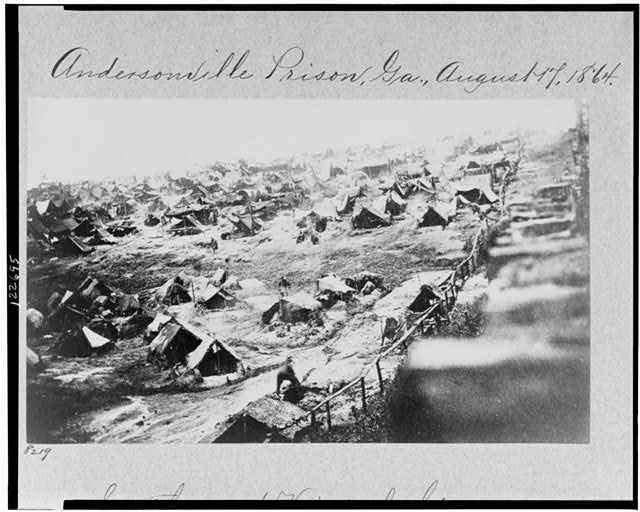
Andersonville Civil War Prison, located in the village of Andersonville, Sumpter County, Georgia, became notorious for its overcrowding, starvation, disease, and cruelty.  It was in operation from February 1864 to April 1865.


Andersonville Prison was established as a "stockade for Union enlisted men".  The prison consisted of 27 acres and was enclosed with walls made of pine logs, which stood 15-20 feet high.  The "stockade" held a hospital but no barracks were ever constructed for the prisoners.  Originally intended to hold 10,000 men, Andersonville at one time held over 33,000 men.  According to records, a total of 49,485 prisoners went through the gates of Andersonville Prison.


Prisoners suffered from hunger, disease, medical shortages, and exposure.  The death rate at Andersonville was the highest of all Civil War prisons.  A staggering 13,700 men died within thirteen months!


The superintendent of the prison was Captain Henry Wirz.  It is said he was heartless and high-handed.  John L. Ransom, a Michigan sergeant and Andersonville prisoner, wrote in his diary on May 10, 1864:  "Captain Wirz very domineering and abusive, is afraid to come into camp any more.  A thousand men here would willingly die if they could kill him first.  The worst man I ever saw."  Captain Wirz was tried and hanged by a military court after the war.


Andersonville Prison was investigated by the Confederate War Department and they recommended that the majority of the prisoners be transferred to Florence, SC and Millen, GA.  This mere fact would attest to the horrors suffered by prisoners at Andersonville.


The prisoner's burial ground is now a National Cemetery and contains 13,737 graves, of which 1,040 are marked unknown.  The area is now designated as a National Park and can be visited.  Visitors will experience a great sense of sorrow upon seeing this vast number of graves.

Surname:    William M. Carr
Rank:    Private
Company:    B
Regiment:    7
State:    WV
Arm of Service:    Cavalry
Death Date:    6 Apr 1864
Cause of Death:    Fever Thypuis
Remarks:    04/05/1864 [1]; William Carr B 8 Virginia, Arm not listed [3]
Reference:    p 67 [3]
Page:    13
More Information:    NO
Code:    10403
Grave:    403
Civil War Veterans~

Union Members.....


The Civil War was the first war in American history in which a substantial proportion of the adult male population participated. Almost every American would have known friends, family members, or neighbors who marched off to war, many never to return. The service records of these men, North and South, are contained in the Civil War Soldiers and Sailors System thru the National Parks Service Web site...


Carr, Clark W

Side:
Union:
Company:
A
Soldier's Rank In:
Musician
Soldier's Rank Out:
Private
Alternate name:

Film Number:
M507 roll 2
- Company A -Enlisted as a Musician FA#365648 - wounded Strasburg VA Kanawha Co. VA son of Ezekiel and Vienna, died 9 July 1866 - Clark had 11 brothers and sisters - Ezekiel and Vienna were married 20 Aug 1840 Cabin Creek Kanawha Co. by a riding minister, Vienna died 1 March 1874 - also lived Winfield WV

Carr, David
Side:
Union:
Company:
H
Soldier's Rank In:
Private
Soldier's Rank Out:
Private
Alternate name:

Film Number:
M507 roll 2

Carr, Francis M

Side:
Union:
Company:
H
Soldier's Rank In:
Private
Soldier's Rank Out:
Private
Alternate name:

Film Number:
M507 roll 2
enlisted 14 Oct 1861 Charleston WV - 6’3” tall, Dark complexion, hazel eyes, dark hair - born about 1826 Kanawha Co. VA Company H - born about 1839 Kanawha Co. VA - deserted and was court martial'd 2 July 1863, he was under arrest at Athenaeum Prison Wheeling WV May 1863, in prison at Fort Delaware DE June 1864 , discharged to wheeling Jan 23,1965 after serving sentence.


Carr, James company B...Private...Private
Birth 1815 in Kanawha County, Virginia, United States
 discharged 2-8- 1862 Peytona , Boone Co. Wv. with disabilitys.Listed as being 5-9 tall, dark comp. dark eyes and dark hair. He worked at the Salt Works in Malden Wv and the US Census shows him as living in Malden at the age of 65. James Past away at the age of 82 in 1897 in Kanawha County 

Car r, William M.Company

Side:
Union:
Company:
B
Soldier's Rank In:
Private
Soldier's Rank Out:
Private
Alternate name:

Film Number:
M507 roll 2
Burial
Death 6 Apr 1864 in Andersonville, Sumter, Georgia, USA
Carr, William M. - Company B - WC#52070, MIC#108977 - enlisted 2 Sep 1861 Peytona, Boone Co. VA - 5’8”tall, dark complexion, brown eyes, dark hair - born about 1824 Jackson Co. WV - died 6 Apr 1864 Andersonville, Prison while a P.O.W. - married Mahala Crawford daughter of Alexander and Elizabeth Crawford 29 Jul 1852, she married later Joseph H. Barker son of Isaac and Spicy 19 Sep 1864 - children: Mary J. born 30 Apr 1853, William 5 Nov 1854, Felix M. 10 Mar 1856
http://www.shepherd.edu/gtmcweb/Consolidated_Listing2.htm


Willey, Eber

Side:
Union:
Company:
G
Soldier's Rank In:
Private
Soldier's Rank Out:
Private
Alternate name:
Eber/Wiley
Film Number:
M507 roll 13
Notes:
Original filed under Eber/Wiley
Civil War Veterans-

Confederate Members...


**Jacob Lee applied for a pension from the war between the states (Civil War) and was approved. He was listed as being with the 19th Va Infantry  and possibly captured at Gettysburg during his time in service

Jacob Lee Hamilton (or Hambleton, depending on who was doing the spelling at the time) who was born Oct. 17, 1841, in Nelson County, Virginia.On May 1, 1861, Jacob, (who was described as being 5'9" in height, with brown eyes and 'light' hair with a sallow complexion) at the age of 21, along with his two brothers, Peter Walker Hamilton and James Madison Hamilton, enlisted as privates into Company G, 19th Virginia Infantry Regiment, The Nelson County Grays. A third brother, Augustus H. Hamilton, enlisted in G.B. Chapman's Company, Virginia Light Artillery (Monroe's Battery).The 19th Virginia Infantry was part of Lee's Army of Northern Virginia and was involved in every major battle from Bull Run to Appomattox Campaign. Jacob Lee Hamilton, along with the 19th, was with Garnett's Brigade in Picket's Charge at Gettysbug. He was captured after the attack at the stone wall near the cospe of trees on July 3, 1863 and sent to Ft. Delaware on July 7, 1863, as a prisoner of war. (It was at the Battle of Sayler's Creek where remainder of the regiment was captured. Only 1 officer and 29 men of the original unit surrendered.)In April of 1865, Jacob took the Oath of Allegiance on June 20, 1865, at Ft. Delaware and was released. He returned to Nelson County, Virginia, where lived until his death on July 27, 1927.Jacob owned seven slaves according to the 1850 US Census, 3 males, 3 females and one six-month old slave child.One interesting fact I discovered concerning Jacob and the 19th Virginia. The 19th had been issued brand-new regimental colors in June of 1863. One month later, these very same colors were captured at Gettysburg at the stone wall by one Pvt. Ben Falls of the 19th Massachusetts Infantry. The flag is now in the Museum of the Confederacy, Richmond, Virginia 

Posted by Unionblue

CivilWarTalk.com - A free and friendly Civil War community.

Make a Free Website with Yola.