Pictured above is The Old Dutch Church in Kingston New York. The names of Cornelius and Tryntje Slecht with about a dozen others
appear on a marble plaque in the vestibule of the Old Dutch Church in
Kingston as the
list of first communicants there. The records also indicate that Cornelius with 2 other property owners had signed a petition asking the church
authorities in Holland for a pastor and pledging their possessions as a guarantee of salary.

In the History of Ulster County by N. Sylvester it states that Slecht's house stood at the millgate of the new town of Wiltwyck in 1661. Wallerand duMont, erected a house next to his two years later. Slecht was one of the first schepens of Wiltwyck. The name Slecht translated is "plain", but although hot-headed, quick, and resentful, Cornelius, though troublesome to the civil authorities, was not a bad man. He emigrated from Woerden, province of South Holland, and settled in Esopus quite early. His wife, Tryntje Tysen Bos, was midwife there in 1655, duly licensed by
Stuyvesant. He occupied an honorable position in society until his death in 1671.
In May 1661, he was appointed to the first board of Schepens by Governor Peter Stuyvesant. He took up arms against the British in 1666 and was severly beaten. He was banished for 3 years due the British altercation and went to Flushing.
- The preceeding was from The History of Ulster County by Nathaniel Sylvester -
Cornelis Barentsen Slecht came from Woerden, Holland with his wife, Tryntje Tysen Bos (Bosch) and at least 4 children on or about the year 1652 on the
ship Purmerlander Kerck with Captain Dirck Jacobsz and settled at Kingston, Ulster Co., NY. In 1655 Slecht's wife was a midwife for Esopus. Although there is a documentary reference to her practicing midwifery, there is no confirmation of her being licensed as early as 1655.
He's credited with being one of the founders of Wiltwick, later called Kingston, and the principal builder of its stockade. He was a miller, brewer and magistrate. He was appointed to the Board of Schepens (Colonial Assembly) as a representative by Gov. Stuyvesant. He was the owner of land in the New Paltz grant, a prominent citizen of civil affairs of Esopus and in those of the church.
Most people in the little inhabited portion of Ulster Co. were Hollanders and recognized the laws of their native country in the new country. At the
beginning, little law was needed. Generally each respected the rights of other. On May 16, 1661 knowledge came to Peter Stuyvesant that Esopus which
had been inhabited 6 or 7 years was without government. He therefore immediately erected the locality into a village and granted it a charter under
the name Wiltwyck, which was afterwards changed to Kingston. The Charter so granted provided punishment for offenses, and required enforcement of the laws of the Fatherland. To this end a Board of Schepens ws created, it being in effect a court with additional powers to look after the county business in
general. The first schepens appointed were Albert Heymans Roos(a), Cornelius Barentsen Slecht and Evert Pels with Roelof Swartwout as Schout. All these
were native Hollanders.
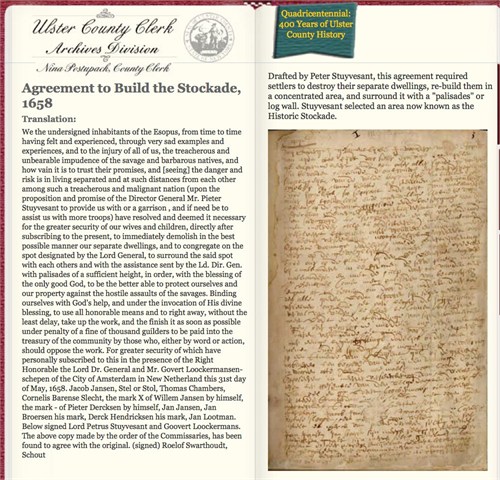
When Slecht and others first came to Ulster County, they settled on land somewhat scattered and unprotected from each other. As outbreaks of trouble arose with the Indians, they decided to remove their houses to a central location and to enclose it with palisades. They entered into a formal contract or bond dated
May 31, 1658. The bond bears the signature of Stoll, Chambers and Slecht and 6 others.
Stuyvesant changed the name of this early settlement from Esopus ot Wildwyck, from the Dutch words "wild", pronounced VILT, meaning wild or savage or Indian and "wyck" pronounced vaik meaning a quarter, ward, parish or district, or a retreat ot refuge. The combined Wildwyck may thus be interpreted in a number of different ways. Items in the Wiltwick court minutes indicate that Cornelis Slecht as early as the spring of 1662 was brewing beer. According to Jonathon Hasbrouck, the brewery was located on the south side of the millgate, and continued in operation into the 19th century. In April 1662 Stuyvesant paid a visit to Esopus. During this visit he retired Slecht. The same year on May 30 the court appointed Cornelis Slecht an officer of the Citizens militia or trainband.
The names of Cornelius and Tryntje Slecht with about a dozen others appear on a marble plaque in the vestibule of the Old Dutch Church in Kingston as the
list of first communicants there. The records also indicate that Cornelius with 2 other property owners had signed a petition asking the church
authorities in Holland for a pastor and pledging their possessions as a guarantee of salary. Among the records of the Reformed Protestant Dutch Church in Kingston we find that on March 4, 1661 Cornelius Slecht, Thomas Chambers, Roeloff Swartwout, Alaerdt Heymensen Roosa and Jurian Westvael agreed in writing to give Domine Blom as a salary for the 1st year, to commence Sept. 5, 1660, the sum of 700 guilders in corn at beaver valuation, in case his farm should fail, and promised further to put the farm in good order, according to contrat, as soon as the land has been allotted and to raise that sum at the latest for the comong farming season.
In the beginning Blom and his wife boarded with Cornelius Slecht. These arrangements did not suit them, and 2 months after their arrival, Dir.
Stuyvesant came to find a boarding place for them.
At the burning of Hurley by the Indians on June 7, 1663, Cornelius Slecht and son, Hendrick, were officially reported as present. The 2nd Esopus War of June
7, 1663, it had been recorded that all captives were rescued except Slecht's daughter. However, there is some conflict in that it was possible she may have
been captured during the First Esopus War, rather than the Esopus Massacre. It's also possible that it was Roosa's daughter and not Slecht's daughter as
a daughter of Albert Heymans Roosa was taken captive in the Esopus Massacre and was still unrecovered as of the end of the year. However it is generally
established that Slecht's daughter married a young warrior and "clove to him faithfully as became a Dutch woman"; she civilized her husband so that he
afterwards left his savage life and settled in Esopus Creek, somewhere around Marbletown. He was called Jan by the settlers.
In the spring of 1664, the English assumed control of New Netherland. The Dutch, traditionally loyal to their fatherland, and of indomitable spirit,
resisited this so far as in their power. An English garrison was established at Wiltwick under the command of Cpt. Daniel Brodhead... Fear of Indian
hostilities was a chief concern of the Esopus settlement but when the English occupation troops came during the first year of English rule in New
Netherland, the Englsih occupation troops soon overshadowed the Indians as an immediate threat to the well-being of the inhabitants. A military dictatorship
descended upon the area when the British Richard Nicols won control. The first serious incident ocurred as early as Feb. 1665 when 6 armed soldiers
marched into a Dutch house and forcibly took away a ham, wounding the woman of the house who tried to prevent the theft.
On Feb. 16, 1666 Slecht took up arms against the English in revolt against their authority and was brutually and severly beaten by a small detachment of
British soldiers. For this, Cornelius was banished for 3 years. Where he went is not clear, although he seems to have gone to Flushing. At least in 1669 he
purchased property there and 3 years later sold it.
Such high handed treatment of the citizenry culminated in the Esopus Meeting of 1667, a demonstration against the English conquerors which had been
precipitated by the arrest and imprisonment of Cornelius Slecht, schepen, brewer, good friend of the innkeeper, and more importantly, a sergeant.
Slecht was reportedly cut, beaten and wounded in his own house by the English military commander, Captain Daniel Brodhead. He must have resisted this
treatment, for a party of 5 soldiers appearing on the scene noticed that Brodhead's face was scratched and his cravat torn away. At the captain's
command, the soldiers spprehended Slecht. One of them reportedly beat him, and Slecht was forcibly taken to prison, where he was allegedly used very hard.
Upon the doleful cry and lamentation of Slecht's wife and children, who alarmed the town, a group of about 5 to 9 men went to the schout's house;
they soon departed, perhaps unsatisfied by measures that the schout may have proposed, or perhaps given tacit permission to take matters into their own
hands. At any rate, about 55 to 70 men, certainly a large portion of the adult male population,were soon in arms headed by Lt. Hendrick Schoonmaker.
The men of Esopuus headed by Hendrick Schoonmaker demanded the release of Slecht from prison. Meanwhile,Tryntje Bos - his wife, complained to the
Wiltwyck court of the beating and imprisonment of her husband. A daughter was with her. After Brodhead refused a request to appear before the magistrates,
the court then sent Thomas Chambers and Evert Pels to Brodhead with a message requesting him to release Slecht from confinement and had the latter offended
him in any manner to seek satisfaction through normal legal proceedings by filing a complaint with the court. Brodhead's arrogant reply was "that he will
keep Cornelius Slecht in apprehension as long as he thinks is good, and in case the inhabitants will fetch him by force, that he would wait upon them ".
A petition was signed by a large number of the inhabitants, was forwarded to the Governor, reciting that upon the 4th day of February last upon the doleful
cry and lamentation of the children of Cornelius Slecht, that their father was miserbly beaten and wounded by Cpt. Brodhead, "they had repaired to his house
and ascertained that the complaint was trus". This was soon followed by another petition that recited " That Cornelis Slecht is beaten in his own
house by his soldier George Porter, and after this by the other soldiers, and forced to prison, and at his imprisonment used very hard and his arms by force
taken out of his house which still do remain by said Cpt. Brodhead."
Matters went from bad to worse, and on April 16, 1667, the Governor appointed a commission to investigate the troubles. This was a mere formality since the
findings had already been prepared. There was to be no jury and few admitted to the hearing. It was easy for the commission to decide that a state of
rebellion and insurrection existed, and that the 4 principal instigators were Antoni d'Elba, Albert Heymans Roosa, Arent Albertson and Cornelis Slecht.
These gentlemen were taken to New York for sentencing, and Roosa was banished for life from the government; the others for shorter terms out of Esopus,
Albany and New York. These sentences were soon modified, and the accused permitted to return home. Brodhead was finally suspended and died July 14,
1667.
On April 25-27, a special court was held at Wildwyck by 3 persons commissioned and sent there by Gov. Nicolls. The court heard evidence from Brodhead and the soldiers concerning the mutiny and also heard the complaints of the inhabitants against the military. Among the latter were recorded :
Tjerk Claesen De Witt was beaten by Cpt. Brodhead and imprisoned because DeWitt would observe Christmas on the day customary with the Dutch, and not on the day accorded by English custom. Albert Heymanse Roosa, waiting for a smith to repair a broken coulter or plow iron, was assaulted and wounded outside the house of Louis de Bois by 5 soldiers and afterward imprisoned. Roeloff Swartwout was assaulted one day in the street by a soldier. Coming to the
house of Louis DuBois, Captain Brodhead took an anker of brandy and threw it upon the ground because DuBois had refused him free brandy. Du Bois was forced to give Brodhead brandy and when Dubois' wife, Catherine Blanchan, came to Brodhead's house to demand payment, the Captain drove her out of the house with a knife, calling her many bad names and told her that were she not with child (David DuBois), he would cut her.
During the proceedings reference was made to a previous meeting in which Albert Hymanse Roosa figured prominently. As a result of the hearings, the
following persons were found guilty of rebellious and mutinous riot :
Antonio Dalva, a Huguenot;
Cornelius Barenson Vos;
Albert Hymanse Roosa and his son, Arient Albertson.
It is unknown how long they were imprisoned. Albert Roosa was back in Wiltwyck by Feb. 7, 1668 apparently a free man. On June 3, 1671, Cornelius Slecht became a Commisary until Oct. 6, 1672. He took the Oath of Allegiance to the English Rule of the Colonies in 1687 after much resistence. Slecht lived to see the Esopus settlement survive the perils of the Indians, the conquest of the English rule and did his part in helping it grow into a major agriculture community of the province.
From New York Land Paper, L, page 23 : Cornelius Barentson (Borensen) "convicted upon oath for taking arms in a ritous and illegal manner upon the 16th February 1666, to awe, terify and supress his Majesty's English Garrison established at Esopus"
"deserves to be put to death" but the Governor sentences to "to be banished for three years, giving him libery to sell his estate at Esopus".
list of first communicants there. The records also indicate that Cornelius with 2 other property owners had signed a petition asking the church
authorities in Holland for a pastor and pledging their possessions as a guarantee of salary.
Stuyvesant. He occupied an honorable position in society until his death in 1671.
In May 1661, he was appointed to the first board of Schepens by Governor Peter Stuyvesant. He took up arms against the British in 1666 and was severly beaten. He was banished for 3 years due the British altercation and went to Flushing.
- The preceeding was from The History of Ulster County by Nathaniel Sylvester -
Cornelis Barentsen Slecht came from Woerden, Holland with his wife, Tryntje Tysen Bos (Bosch) and at least 4 children on or about the year 1652 on the
ship Purmerlander Kerck with Captain Dirck Jacobsz and settled at Kingston, Ulster Co., NY. In 1655 Slecht's wife was a midwife for Esopus. Although there is a documentary reference to her practicing midwifery, there is no confirmation of her being licensed as early as 1655.
He's credited with being one of the founders of Wiltwick, later called Kingston, and the principal builder of its stockade. He was a miller, brewer and magistrate. He was appointed to the Board of Schepens (Colonial Assembly) as a representative by Gov. Stuyvesant. He was the owner of land in the New Paltz grant, a prominent citizen of civil affairs of Esopus and in those of the church.
Most people in the little inhabited portion of Ulster Co. were Hollanders and recognized the laws of their native country in the new country. At the
beginning, little law was needed. Generally each respected the rights of other. On May 16, 1661 knowledge came to Peter Stuyvesant that Esopus which
had been inhabited 6 or 7 years was without government. He therefore immediately erected the locality into a village and granted it a charter under
the name Wiltwyck, which was afterwards changed to Kingston. The Charter so granted provided punishment for offenses, and required enforcement of the laws of the Fatherland. To this end a Board of Schepens ws created, it being in effect a court with additional powers to look after the county business in
general. The first schepens appointed were Albert Heymans Roos(a), Cornelius Barentsen Slecht and Evert Pels with Roelof Swartwout as Schout. All these
were native Hollanders.
When Slecht and others first came to Ulster County, they settled on land somewhat scattered and unprotected from each other. As outbreaks of trouble arose with the Indians, they decided to remove their houses to a central location and to enclose it with palisades. They entered into a formal contract or bond dated
May 31, 1658. The bond bears the signature of Stoll, Chambers and Slecht and 6 others.
Stuyvesant changed the name of this early settlement from Esopus ot Wildwyck, from the Dutch words "wild", pronounced VILT, meaning wild or savage or Indian and "wyck" pronounced vaik meaning a quarter, ward, parish or district, or a retreat ot refuge. The combined Wildwyck may thus be interpreted in a number of different ways. Items in the Wiltwick court minutes indicate that Cornelis Slecht as early as the spring of 1662 was brewing beer. According to Jonathon Hasbrouck, the brewery was located on the south side of the millgate, and continued in operation into the 19th century. In April 1662 Stuyvesant paid a visit to Esopus. During this visit he retired Slecht. The same year on May 30 the court appointed Cornelis Slecht an officer of the Citizens militia or trainband.
The names of Cornelius and Tryntje Slecht with about a dozen others appear on a marble plaque in the vestibule of the Old Dutch Church in Kingston as the
list of first communicants there. The records also indicate that Cornelius with 2 other property owners had signed a petition asking the church
authorities in Holland for a pastor and pledging their possessions as a guarantee of salary. Among the records of the Reformed Protestant Dutch Church in Kingston we find that on March 4, 1661 Cornelius Slecht, Thomas Chambers, Roeloff Swartwout, Alaerdt Heymensen Roosa and Jurian Westvael agreed in writing to give Domine Blom as a salary for the 1st year, to commence Sept. 5, 1660, the sum of 700 guilders in corn at beaver valuation, in case his farm should fail, and promised further to put the farm in good order, according to contrat, as soon as the land has been allotted and to raise that sum at the latest for the comong farming season.
In the beginning Blom and his wife boarded with Cornelius Slecht. These arrangements did not suit them, and 2 months after their arrival, Dir.
Stuyvesant came to find a boarding place for them.
At the burning of Hurley by the Indians on June 7, 1663, Cornelius Slecht and son, Hendrick, were officially reported as present. The 2nd Esopus War of June
7, 1663, it had been recorded that all captives were rescued except Slecht's daughter. However, there is some conflict in that it was possible she may have
been captured during the First Esopus War, rather than the Esopus Massacre. It's also possible that it was Roosa's daughter and not Slecht's daughter as
a daughter of Albert Heymans Roosa was taken captive in the Esopus Massacre and was still unrecovered as of the end of the year. However it is generally
established that Slecht's daughter married a young warrior and "clove to him faithfully as became a Dutch woman"; she civilized her husband so that he
afterwards left his savage life and settled in Esopus Creek, somewhere around Marbletown. He was called Jan by the settlers.
In the spring of 1664, the English assumed control of New Netherland. The Dutch, traditionally loyal to their fatherland, and of indomitable spirit,
resisited this so far as in their power. An English garrison was established at Wiltwick under the command of Cpt. Daniel Brodhead... Fear of Indian
hostilities was a chief concern of the Esopus settlement but when the English occupation troops came during the first year of English rule in New
Netherland, the Englsih occupation troops soon overshadowed the Indians as an immediate threat to the well-being of the inhabitants. A military dictatorship
descended upon the area when the British Richard Nicols won control. The first serious incident ocurred as early as Feb. 1665 when 6 armed soldiers
marched into a Dutch house and forcibly took away a ham, wounding the woman of the house who tried to prevent the theft.
On Feb. 16, 1666 Slecht took up arms against the English in revolt against their authority and was brutually and severly beaten by a small detachment of
British soldiers. For this, Cornelius was banished for 3 years. Where he went is not clear, although he seems to have gone to Flushing. At least in 1669 he
purchased property there and 3 years later sold it.
Such high handed treatment of the citizenry culminated in the Esopus Meeting of 1667, a demonstration against the English conquerors which had been
precipitated by the arrest and imprisonment of Cornelius Slecht, schepen, brewer, good friend of the innkeeper, and more importantly, a sergeant.
Slecht was reportedly cut, beaten and wounded in his own house by the English military commander, Captain Daniel Brodhead. He must have resisted this
treatment, for a party of 5 soldiers appearing on the scene noticed that Brodhead's face was scratched and his cravat torn away. At the captain's
command, the soldiers spprehended Slecht. One of them reportedly beat him, and Slecht was forcibly taken to prison, where he was allegedly used very hard.
Upon the doleful cry and lamentation of Slecht's wife and children, who alarmed the town, a group of about 5 to 9 men went to the schout's house;
they soon departed, perhaps unsatisfied by measures that the schout may have proposed, or perhaps given tacit permission to take matters into their own
hands. At any rate, about 55 to 70 men, certainly a large portion of the adult male population,were soon in arms headed by Lt. Hendrick Schoonmaker.
The men of Esopuus headed by Hendrick Schoonmaker demanded the release of Slecht from prison. Meanwhile,Tryntje Bos - his wife, complained to the
Wiltwyck court of the beating and imprisonment of her husband. A daughter was with her. After Brodhead refused a request to appear before the magistrates,
the court then sent Thomas Chambers and Evert Pels to Brodhead with a message requesting him to release Slecht from confinement and had the latter offended
him in any manner to seek satisfaction through normal legal proceedings by filing a complaint with the court. Brodhead's arrogant reply was "that he will
keep Cornelius Slecht in apprehension as long as he thinks is good, and in case the inhabitants will fetch him by force, that he would wait upon them ".
A petition was signed by a large number of the inhabitants, was forwarded to the Governor, reciting that upon the 4th day of February last upon the doleful
cry and lamentation of the children of Cornelius Slecht, that their father was miserbly beaten and wounded by Cpt. Brodhead, "they had repaired to his house
and ascertained that the complaint was trus". This was soon followed by another petition that recited " That Cornelis Slecht is beaten in his own
house by his soldier George Porter, and after this by the other soldiers, and forced to prison, and at his imprisonment used very hard and his arms by force
taken out of his house which still do remain by said Cpt. Brodhead."
Matters went from bad to worse, and on April 16, 1667, the Governor appointed a commission to investigate the troubles. This was a mere formality since the
findings had already been prepared. There was to be no jury and few admitted to the hearing. It was easy for the commission to decide that a state of
rebellion and insurrection existed, and that the 4 principal instigators were Antoni d'Elba, Albert Heymans Roosa, Arent Albertson and Cornelis Slecht.
These gentlemen were taken to New York for sentencing, and Roosa was banished for life from the government; the others for shorter terms out of Esopus,
Albany and New York. These sentences were soon modified, and the accused permitted to return home. Brodhead was finally suspended and died July 14,
1667.
On April 25-27, a special court was held at Wildwyck by 3 persons commissioned and sent there by Gov. Nicolls. The court heard evidence from Brodhead and the soldiers concerning the mutiny and also heard the complaints of the inhabitants against the military. Among the latter were recorded :
Tjerk Claesen De Witt was beaten by Cpt. Brodhead and imprisoned because DeWitt would observe Christmas on the day customary with the Dutch, and not on the day accorded by English custom. Albert Heymanse Roosa, waiting for a smith to repair a broken coulter or plow iron, was assaulted and wounded outside the house of Louis de Bois by 5 soldiers and afterward imprisoned. Roeloff Swartwout was assaulted one day in the street by a soldier. Coming to the
house of Louis DuBois, Captain Brodhead took an anker of brandy and threw it upon the ground because DuBois had refused him free brandy. Du Bois was forced to give Brodhead brandy and when Dubois' wife, Catherine Blanchan, came to Brodhead's house to demand payment, the Captain drove her out of the house with a knife, calling her many bad names and told her that were she not with child (David DuBois), he would cut her.
During the proceedings reference was made to a previous meeting in which Albert Hymanse Roosa figured prominently. As a result of the hearings, the
following persons were found guilty of rebellious and mutinous riot :
Antonio Dalva, a Huguenot;
Cornelius Barenson Vos;
Albert Hymanse Roosa and his son, Arient Albertson.
It is unknown how long they were imprisoned. Albert Roosa was back in Wiltwyck by Feb. 7, 1668 apparently a free man. On June 3, 1671, Cornelius Slecht became a Commisary until Oct. 6, 1672. He took the Oath of Allegiance to the English Rule of the Colonies in 1687 after much resistence. Slecht lived to see the Esopus settlement survive the perils of the Indians, the conquest of the English rule and did his part in helping it grow into a major agriculture community of the province.
From New York Land Paper, L, page 23 : Cornelius Barentson (Borensen) "convicted upon oath for taking arms in a ritous and illegal manner upon the 16th February 1666, to awe, terify and supress his Majesty's English Garrison established at Esopus"
"deserves to be put to death" but the Governor sentences to "to be banished for three years, giving him libery to sell his estate at Esopus".